<<<< .پڑھیں.. نقاب ، حجاب: قرآن , حدیث اور اجماع >>>
Pages
- Front Page
- Women & Islam
- Modesty
- Marriage, Divorce
- Topics
- Inheritance
- Polygamy
- Motherhood
- Right to Work
- Evidence
- Paradise
- Slavery
- Women in West
- Great Muslim Women
- Hijab & Niqab
- Quran Subjects
- Just1God
- Misconceptions
- Why Religion?
- Why Islam?
- God & Science
- Atheism
- Abraham to Muhammad
- Tolerance
- eBook
- Videos
- Youtube
- Home
Women Modesty & Piety in Islam - Hijab and Niqab (3 of 3)
<<<< .پڑھیں.. نقاب ، حجاب: قرآن , حدیث اور اجماع >>>
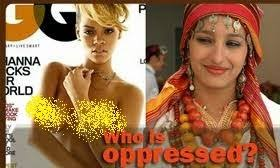
Women in the Western Culture
Women Protection and Violence against Women & Islam
They always emphasise that Quran is best explained through Sunnah of Prophet (pbuh), known as living Quran by the mother of believers Hazrat Ayesha (R.A). He never beat any one of his wives. Rather he said: “Could any of you beat his wife as he would beat a slave, and then lie with her in the evening?”(Prophet Muhammad (pbuh) Sahih Bukhari;8.68 and Muslim).
There is need to look in to the matter deeply to be careful not to be like scholars of the people of the book: "There are some among them who distort the Book by the way they speak to make you think that what they say is from the Book, whereas it is not. They say it is from God whereas it is not. Thus they tell a lie about God and they know it." (Quran;3:78)
Domestic violence is very old menace, Arabs were no exception, and their maltreatment to women is a well known historic fact. They used to beat their women on small matters as it is still vogue in all the underdeveloped as well as the most developed societies of the world, where special laws have been made to discourage it. In the year 1995 in USA alone the lawmakers showed a heightened awareness of and sensitivity to domestic violence, with several states increasing penalties for abusers. New York enacted the omnibus Family Protection and Domestic Violence Act, and Maryland passed three new domestic-violence laws. Colorado passed five domestic-violence bills, including one that mandated arrest for the violation of a restraining order and jail time for a second offense. Virginia passed a number of laws with stiffer penalties for domestic violence, while Michigan had 14 new laws that would help in prevention and prosecution. This menace was handled in Islam objectively, by formulating the guidelines where by men can not resort to use of force against their wives as per their wish every now and then on minor matters. Allah says in Qur’an: “Men are overseers over women because Allah has given the one more strength than other, and because men are required to spend their wealth for the maintenance of women. Honorable women are, therefore, devoutly obedient and guard in the husband's absence what Allah require them to guard their husband's property and their own honor. As to those women from whom you fear disloyalty and ill-conduct, first admonish them, then refuse to share your bed with them, and (and last) if necessary beat them (lightly); Then if they obey you, take no further actions against them and do not make excuses to punish them. Allah is Supremely Great and is aware of your actions.”(Qur’an;4:34).
It is evident from many authentic Traditions that the Prophet himself intensely detested the idea of beating one’s wife and said on more than one occasion, “Could any of you beat his wife as he would beat a slave, and then lie with her in the evening?”(Sahih Bukhari;8.68 and Muslim).
With all this, he stipulated in his sermon the occasion of the Farewell Pilgrimage, shortly before his death that, beating should be resorted to only if the wife “has become guilty, in an obvious manner, of immoral conduct”, and that it should be done “in such a way as not to cause pain (ghayar mubarrih)”; authentic Traditions to this effect are found in Muslim, Tirmidhi, Abu Dawood, Nasa’I and Ibn Majah.
On the basis of these Traditions, all the authorities stress that this “beating”, if resorted to at all, should be more or less symbolic – “with a toothbrush (muswak), or some such thing” (Tibri, quoting the views of scholars of the earliest times), or even “with a folded handkerchief” (Razi); and some of the greatest Muslim scholars (e.g., Ash-Safi’i) are of the opinion that it is just barely permissible, and should preferably be avoided: and they justify this opinion by the Prophet’s personal feelings with regard to this problem. [Commentary by M.Asad].
In case all the efforts fail the family council is recommended in the next verse:
“If you fear a breach of marriage between a man and his wife, appoint one arbiter from his family and another from hers; if they wish to reconcile, Allah will create a way of reconciliation between them. Allah is the Knowledgeable, Aware.”(Qur’an;4:35).
Allah says: “You have indeed, in the life of Messenger of Allah, the 'Best Model' for him whose hope is in Allah and the Day of the Hereafter, and who engages himself much in the remembrance of Allah.”(Qur’an;33:21), “Obey Allah and obey His messenger;” (Qur’an;64:12). Prophet Muhammad (peace be upon him) is not reported to have used force against his wives. In fact he has been very kind to them. Narrated Aisha, Ummul Mu'minin: Habibah daughter of Sahl was the wife of Thabit ibn Qays Shimmas. He beat her and broke some of her part. So she came to the Prophet (peace be upon him) after morning, and complained to him against her husband. The Prophet (peace be upon him) called on Thabit ibn Qays and said (to him): Take a part of her property and separate yourself from her. He asked: Is that right, Apostle of Allah? He said: Yes. He said: I have given her two gardens of mine as a dower, and they are already in her possession. The Prophet (peace be upon him) said: Take them and separate yourself from her. (Sunan of Abu-Dawood, Hadith Number. 915). Narrated Laqit ibn Sabirah: Messenger of Allah, I have a wife who has something (wrong) in her tongue, i.e. she is insolent. He said: Then divorce her. I said: Messenger of Allah, she had company with me and I have children from her. He said: Then ask her (to obey you). If there is something good in her, she will do so (obey); and do not beat your wife as you beat your slave-girl. (Sunan of Abu-Dawood, Hadith Number. 72).
Narrated Mu'awiyah ibn Haydah: I said: Apostle of Allah, how should we approach our wives and how should we leave them? He replied: Approach your tilth when or how you will, give her (your wife) food when you take food, clothe when you clothe yourself, do not revile her face, and do not beat her. (Sunan of Abu-Dawood, Hadith Number. 878).
It may be reasonable to conclude that it is permissible (not compulsory, undesirable) for the husband to use force lightly under extreme circumstance involving disloyalty and ill-conduct by his wife but only after fulfilling certain conditions i.e. first admonishing, then declining to share bed with her. It is obvious that these are not abrupt or emotional acts but, rational and gradual actions which should result in corrective positive response from the wife. If she obeys, then it is forbidden to take any further actions against her or to make excuses to punish, since the matter stands resolved. However if she does not improve her conduct, then the other option is divorce, but prior to it a light coercive action (just barely permissible, and should preferably be avoided) may save the marriage. It is obvious that any pious and sane woman will not create such conditions; she may desist during first two steps. The killing of women on suspicion of ill-conduct termed as ‘Honor Killing’ (karokari) prevalent in many societies is totally against teachings of Islam.
The Islamic Response to Domestic Violence — EthnoMed
"Under no circumstances is violence against women encouraged or allowed in Islam. There are many examples in Quran and Ahadith that describes the ...
HQ: Peace Conference 2009 - Women's Rights in Islam by Dr. Zakir Naik - Part 2/21 - YouTube
Nov 3, 2009 - Uploaded by ShahadahProjectHQ: Peace Conference 2009 - Women's Rights inIslam by Dr. Zakir Naik - Part 2/21 ... the billion plus population of India, Dr. Zakir Naik was rankedNo. ... Shaikh Ahmed Deedat, Yusuf Estes, Yassir Fazaga, Yasir Qadhi, Dr.
Muslim Women and Islam The Deen Show - YouTube
Nov 8, 2013 - Uploaded by ISLAM IS THE TRUTH - THE MUSLIM YOUTUBE CHANNELAbraham Africa Allah American American Muslimbible christianity Comparative ... Ties Spirituality Submission terrorism The Holy Quran Verse of the Week Violence ... Declaration Yusuf EstesMy Path Islam Maori New Zealander Surah Al Kawthar ... Are You Against ISLAM & MUSLIMS Then Watch This!

- Click here to read online or download PDF
- Online or Download as Google Doc or formats of choice
Woman granted right of Divorce , Khula
Maintenance Allowance for Divorced Women:
Islam safeguards the interest of a divorcee woman, by making it obligatory for the provision of maintenance allowance, Allah says: “Reasonable provisions (maintenance allowance) must also be made for divorced women (till she remarries). That is an obligation upon those who fear Allah.”(Qur’an;2:241). “Let those women, during their waiting period ('Iddat), live where you yourselves live according to your means. You shall not harass them so as to make life intolerable for them. If they are pregnant, maintain them until their delivery: and if, after that, they suckle your offspring, compensate them and settle the matter of compensation with mutual consultation and in all fairness. But if you cannot bear with each other then let another woman suckle the baby for you. Let the rich man give according to his means, and the poor man give according to what Allah has given him. Allah does not charge a man with more than He has given him; soon Allah may bring ease after hardship.”( Qur’an;65:6-7).
Women Granted the Right to Divorce (Khula):
Islam granted the right of divorce to women 1400 years ago, once no woman could dream of this freedom. In the procedure for divorce by man, it was ensured that sufficient checks and balances are in built to avoid impulsive decision which may have to be regretted later. Allah says in Qur’an: “Pronouncement of revocable divorce is only allowed twice: then she should be allowed to stay with honor or let go with kindness after the third pronouncement. It is not lawful for husbands to take anything back which they have given them except when both parties fear that they may not be able to follow the limits set by Allah; then if you fear that they both will not be able to keep the limits of Allah, there is no blame if, by mutual agreement the wife compensates the husband to obtain divorce. These are the limits set by Allah; do not transgress them, and those who transgress the limits of Allah are the wrongdoers.”(Qur’an;2:229).
Where divorce for mutual incompatibility is allowed, there is danger that the parties might act hastily, then repent, and again wish to separate. To prevent such capricious action repeatedly, a limit is prescribed; two divorces (with reconciliation between) are allowed. After that the parties must definitely make up their minds, either to dissolve their union permanently, or to live honourable lives together in mutual love and forbearance - to "hold together on equitable terms," neither party worrying the other nor grumbling or evading the duties and responsibilities of marriage. However If a separation is inevitable, the parties should not throw mud at each other, but recognize what is right and honourable on a consideration of all the circumstances.
In any case a man is not allowed to ask back for any gifts or property he may have given to the wife. This is for the protection of the economically weaker sex. Lest that protective provision itself work against the woman's freedom, an exception is made. All the prohibitions and limits prescribed are in the interest of good and honourable lives for both sides, and in the interests of a clean and honourable social life, without public or private scandals. If there is any fear that in safeguarding her economic rights, her very freedom of person may suffer, the husband refusing the dissolution of marriage, and perhaps treating her with cruelty, then, in such exceptional cases, it is permissible for the woman to seek divorce (Khula) but she has to return the dower she received form the husband at the time of marriage as she is breaking the contract.
A divorce of this kind is called Khula. Divorce is most undesirable act, narrated by Muharib :The Prophet (peace be upon him) said: Allah did not make anything lawful more abominable to Him than divorce. (Sunan of Abu-Dawood, Hadith Number. 893). The women are free to marry any one else after divorce on completion of waiting period: “When you have divorced women and they have reached the end of their waiting period do not prevent them from marrying other men if they have come to an honorable agreement. This is enjoined on everyone amongst you who believes in Allah and the Last Day. This is more virtuous and chaste for you; Allah knows what you do not know.”(Qur’an;2:232)
- Honorable Status of Women in Islam
- Women Modesty & Piety in Islam
- Marriage: Right of Choice, Divorce & Dower
- Women's Inheritance
- Polygene, Polygamy
- Woman granted right of Divorce , Khula
- Mother, Children & Family
- Women's right to Entrepreneurship in Islam
- Evidence by Women
- Women and Paradise
- Slavery
- Women in the Western Culture
- Prominent Muslim Women
- Hijab - Women may not cover Face
- Women & History
- E Book Women
WOMEN IN ISLAM
Online or Download as Google Doc or formats of choice
Peace Forum Network
Peace Forum Network Mags
Books, Articles, Blogs, Magazines, Videos, Social Media
Overall 2 Million visits/hits
Symbol of honour
Purdah in Practice Development
In the medieval Indian society, purdah was common with the Muslim ladies. Strict purdah originated with Amir Timer; when he conquered India and entered in this country with his army and womenfolk. He made the proclamation, “As they were now in the land of idolatry and amongst a strange people, the women of their families should be strictly concealed from the view of stranger[s]”. Purdah, thus, became common among the Muslim ladies, although it was not as rigid with the Hindu women. A girl started observing seclusion near her puberty and generally, continued to adhere to it till her death.
The Muslim men were very zealous in guarding their women from public gaze and considered it a dishonour if they were exposed unveiled. Monserrate, mentioning about harem ladies of Akbar’s time, wrote that they “are kept rigorously secluded from the sight of men”. Similarly, Manucci, writing during the time of Shah Jahan and Aurangzeb, recorded, “[T]he Mahomedans are very touchy in the matter of allowing their women to be seen, or even touched by hand ... .” At [an]other place, he writes that amongst them, “it was a great dishonour for a family when a wife is compelled to uncover herself”. He also refers to an incident concerning this wherein a soldier was travelling in a cart along with his wife and daughter, when the tax collectors tried to check his cart by force. The soldier became so furious that he chopped off the head of that tax collector and also wounded many of his attendants. Thereafter, feeling dishonoured, as his wife and daughter had been seen by the tax collectors, he killed both the ladies too. Similarly, Amir Khan, a noble, felt dishonoured when his wife could not observe purdah in an effort to save her life by jumping from the back of an elephant she was riding, who had run amuck, and decided to divorce her. Shah Jahan rebuked him and forbade him from doing so. They were so protective of their women that they would not allow their wives to talk even to their relatives except in their presence. Consequently, all Muslim ladies, except those belonging to peasant or inferior servants, followed purdah strictly.
A treatise on the lives of Muslim women of the subcontinent from the 13th to 18th century
Two factors were mainly responsible for this. Firstly, since the royalty and nobility religiously practised it [purdah] to maintain their exclusiveness, it came to be regarded as a symbol of respectability. It percolated down but only to the extent the lower classes were able to afford it. Secondly, the threat of invaders and also the sensual laxity and outrages perpetrated by the Muslim royalty and nobility of the sultanate and the Mughal periods had instilled a sense of insecurity among the Muslim subjects and also among the Hindus. Consequently, they relegated their women meekly behind the purdah so as to save them from the lustful eyes of these masters. The more was the slackening of morals, the stricter became the rules of women[’s] seclusion. A majority of the Muslim population of India were Hindu converts. These neoMuslims were more zealous in following the tenets of the faith embraced than those to whom it came as a matter of course. Such persons enforced the purdah norms most assiduously upon their womenfolk.
There was a direct nexus between the rules of Muslim marriage and purdah. The Quran has prescribed the list of prohibited relations with whom one cannot enter into a matrimonial alliance. Such persons are called mahrams. Purdah from such persons was only a matter of routine and not strictly enforced. All others, that is, those with whom matrimonial alliance can be established are called namahrams. Purdah was strictly propounded from such persons. The contemporary society tried to compensate itself for the weakening moral values of the menfolk by overemphasising the chastity and morality of a girl. Purdah was taken as the safest instrument to avoid contact with the namahrams. Under the conditions, the menfolk not only refrained from giving social freedom to their women but also abstained from marrying the ladies who enjoyed such liberties.
Observance of Purdah
From the beginning, the royal and aristocratic classes, with the exception of the Turkish women and a few others, were more rigid in adhering to the rules of purdah. Not only did the walls of the harem become higher and stronger with the passage of time, the restrictions imposed also increased successively. So strict was their seclusion that even when they fell ill, the attending doctors were not allowed to touch and feel their pulse. Therefore, for their examination, a handkerchief was first wrapped all over the body of the patient, this cloth was then dipped into a jar of water and it was through its smell that they were required to diagnose the disease and prescribe the medicine. Later on, some selected physicians like Bernier and Manucci were allowed to feel the pulse of the harem ladies. But such special privilege was given to them only after an established familiarity and a long testing. They were also subjected to surprise checks. Manucci narrated that once when he stretched his hand inside the curtain to feel the pulse of a ladypatient, it turned out to be the hand of Shah Alam himself. Nonetheless, these physicians were not permitted to see the ladies. Whenever their services were required inside the harem, their heads were covered by the thick shawl hanging down to their waist or feet and were led in and brought out like blind men by the eunuchs. The ladies also were such touchmenots that if they were to show some ailing part of their body to the doctor, they would see to it that he could see only that part. Even the old mother of Shah Alam, who needed to be operated upon for gout twice a year, would put her arm out from the curtain, only uncovering two fingers wide of the affected part and the rest of it would be carefully covered with cloth.
The whole outer world was inaccessible for these ladies. If ever they moved out, it was in covered palkis and dolas surrounded on all sides by alert guards. So much so that if they were to travel on elephants, they would ride them inside a tent pitched near the palace gate. Even the mahouts of the elephants covered their heads so that they could not see the royal ladies while they rode the animals. On the elephantbacks, they sat inside covered haudas. Their slave girls were also made to move in covered conveyances. The slave girls of Tatar Khan, a noble of Sultan Firoz Shah Tughlaq, were reportedly carried in locked conveyances lest the eyes of namahrams would [sic] fall on them.
Purdah, infact, had come to be regarded as a symbol of honour. The worst punishment they could think of for their enemies was to parade their womenfolk unveiled and [the] best honour they could extend to a person was by asking their harem ladies to unveil themselves before him. Describing about a custom prevalent on the Malabar coast, Ovington wrote that the husbands, “even the prime nobility” offered their wives to the guests as a mark of welcome to them and refusing the offer was considered as an “affront”. That is why the women there gained the name of “Malabar Quills”.
The stress on observance of purdah differed during different periods. Muhammad bin Tughlaq, for example, was so scrupulous in this regard that when he entered his harem, he was careful that his eyes did not fall on a “namahram.”
It is, however, interesting to note that contrary to Indian conditions, there was no complete seclusion of Turkish ladies from the outside world. Annette Beveridge wrote, “It appears probable that there was no complete seclusion of Turki women from the outside world as came to be the rule in Hindustan. The ladies may have veiled themselves but they received visitors more freely ... .” She noted how the senior nobles and officers of Babur regaled harem ladies in Kabul with interesting stories about India. According to Gulbadan, the ladies of royal harem of Humayun mixed freely with their friends and visitors, went out dressed like males at times, enjoyed picnics and music with their mates, played polo and so on. She has described numerous such occasions. Manrique recorded that he dined with Wazir Asaf Khan and met the Emperor and many members of the imperial family and in the feast, many unveiled ladies of rank took their seats at the table. In Meena Bazar, all ladies appeared without purdah following the principle, as narrated by the author of QanuniIslam, that “women need not be veiled before the king or a bridegroom, both known as Shah”.
There are, at least, two clear examples, those of Razia and Nur Jahan, when a lady came out of the covering of the burqa and discharged the administrative responsibilities like their male counterparts. Nur Jahan even came to the balcony for Jharokha-Darshan (a daily practice of public audience by the king at the balcony). Rajput queens in the Mughal harems did not observe purdah on many occasions. Similarly, the Kashmiri women guards of the palace were, generally, found without purdah. The lively paintings of Maham Anaga in AkbarNama, with her impressive facial contours and white and yellow robes, clearly indicates that it could not be the work of imagination but of someone who had observed her closely. In the later Mughal period, Mughlani Begam looked after administration of Punjab without observing any purdah.
The above excerpt is taken from the chapter ‘The Harem and Purdah’.
Excerpted with permission from
The Status of Muslim Women in Medieval India
By Sudha Sharma
Sage Publications India Pvt Ltd
ISBN 978-9351505662
269pp.
http://www.dawn.com/news/1259967/the-symbol-of-honour
American Evangelical Christian college professor women suspended for wearing Hijab as solidarity with Muslim women & says: 'Muslims and Christians worship the same God'
Follow @Peace_Forum
“For there stood by me this night an angel, belonging to the God whose I am and whom I serve,”[Acts;27:23]
"The God of Abraham, Isaac, and Jacob—the God of our forefathers —has glorified his servant Jesus ...." (Acts;3:13)"God also said to Moses, "Say to the Israelites, 'The LORD, the God of your fathers--the God of Abraham, the God of Isaac and the God of Jacob--has sent me to you.'"(Exodus; 3:15)
"I am the God of your fathers, the God of Abraham, Isaac and Jacob.' Moses trembled with fear and did not dare to look"(Acts;7:32).
"O':People of the Book, (Jews & Christians) why do you dispute about Abraham when the Torah and Gospel were only sent down after him. Do you not use your reason? (65) You are those who disputed about things of which you had some knowledge. Must you now argue about things of which you have no knowledge? God knows, but you do not know. (66) Abraham was neither a Jew nor a Christian. He was an upright man, one who had surrendered himself to God. He was not one of those who associate partners with God. (67) Surely, the people who are closest to Abraham are those who followed him and this Prophet [Muhammad], and those who believe in him. God is the guardian of the believers."(Quran: 3:65-68)
Keep reading >>
I don't love my Muslim neighbor because s/he is American.I love my Muslim neighbor because s/he deserves love by...Read Full post: www.facebook.com/larycia/posts/10153326773658481
Posted by Larycia Alaine Hawkins on Thursday, December 10, 2015
https://www.facebook.com/aftabkhaan/posts/1185115034850972?pnref=storyThis brave Christian lady Larycia Alaine Hawkins has the courage to stand up to publicly display solidarity with Muslim women by wearing Hijab, just on the basis of humanity...... reject Islamophobia... She has been sent on leave..... it reminds verse from Quran: ...There is a community among the People of the Book who are upright. They recite God’s signs throughout the night, and they prostrate. They believe in God and the Last Day, and enjoin the right and forbid the wrong, and compete in doing good. They are among the righteous.You will not be denied the reward for any good thing you do. Allah knows those who fear Allah. (Quran;3: 113-115)
Evangelical Christian college professor who vowed to wear a hijab for the holidays and declared 'Muslims and Christians worship the same God' is suspended:
- Larycia Alaine Hawkins is professor at Chrisitian Wheaton College, Illinois
- Said on Facebook this week that she is wearing a hijab for the holidays
- Gesture is to show 'solidarity' with Muslims across America, she said
- Added that both Muslims and Christians 'worship the same God'
- Ms Hawkins has now been suspended, the school announced today
- A statement from officials implied that Ms Hawkins had breached the school's Statement of Faith, but did not make it clear how she had done so.
Peace Forum Network
Peace Forum Network Mags
Books, Articles, Blogs, Magazines, Videos, Social Media
Overall 2 Million visits/hits
Featured post
Front Page
Generally it is believed that in Islam the women are mistreated, their status is lower than men and they do not enjoy equal rights. ...
-
Arguments Against Niqab: <<<< اردو میں . پڑھیں .. نقاب ، حجاب: قرآن , حدیث اور اجماع >>> There is no c...
-
’شریعت میں خواتین کے چہرے کا پردہ واجب نہیں‘- اسلامی نظریاتی کونسل پاکستان نقاب ، حجاب: قرآن , حدیث اور اجماع... پڑھیں>>...
-
Muslim Women need not to Cover Face in Hijab... by Peace-Forum <<<< . پڑھیں .. نقاب ، حجاب: قرآن , حدیث اور اجماع >...