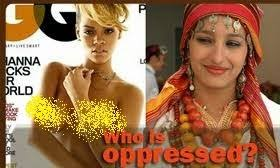
Equality: Men and women are absolutely equal with regard to their human status. The Qur’an, and the Prophet (peace be upon him), stress the equality of the two sexes in clear terms. The Qur’anic address always applies to men and women equally, at times the women and men are also addressed together:
“Surely the Muslim men and the Muslim women, the believing men and the believing women, the devout men and the devout women, the truthful men and the truthful women, the patient men and the patient women, the humble men and humble women, the charitable men and the charitable women, the fasting men and the fasting women, the men who guard their chastity and the women who guard their chastity, and the men who remember Allah much and the women who remember Allah much - for all those, Allah has prepared forgiveness and a great reward”( Qur’an;33:35). Yet there are occasions where women are addressed in the Qur’an on their own, with matters that apply to them only. On the contrary, Islam stresses equality of treatment of sons and daughters. Allah says in the Qur'an: "Mankind, remain conscious of your Lord, who has created you all out of a single soul, and out of it created its mate."(Qur’an;4:1).
The women in the western
culture have always been oppressed. The women had to launch the movements, to
get the rights. There are diverse social movement, largely based in the U.S., seeking equal
rights and opportunities for women in their economic activities, personal
lives, and politics. Though one can not agree with the all the aspects of the
Nazi philosophy, but the one good aspect was that, it advocated the role of
women to domestic duties and motherhood.
Adolf Hitler set up Organization in 1933, named as Hitler-Jugend (Hitler
Youth); for educating and training male youths aged 13–18 in Nazi principles. A parallel organization, the ‘League of German Girls’, trained
girls for domestic duties and motherhood. Though women were not totally
segregated but this philosophy did not have any negative effect on the economy,
rather positively contributed in the social sector. The famous saying. “give me
good mothers, I shall give you strong nation ” stands validated again.
Generally it is believed that in Islam the women are mistreated, their status is lower than men and they do not enjoy equal rights. Such negative perceptions has been created by the ignorant and enemies of Islam, after having failed in the ideological front, however the cultural treatment meted to the women in some of the Muslim societies has provided the basis for such perception.
Before the advent of Islam the status of women in earlier civilizations was very low to the extent that they were denied basic human dignity. A cursory look at that would highlight the respectable position granted to women by Islam. The women were degraded and were denied all rights under the Babylonian law. If a man murdered a woman, instead of him being punished, his wife was put to death. In the Greek Civilization, women were deprived of all rights and were looked down upon. In Greek mythology, an ‘imaginary woman’ called ‘Pandora’ is the root cause of misfortune of human beings. The Greeks considered women to be subhuman to the extent that they were considered impure, and they were bought and sold in marketplaces.
A woman could not refuse a husband chosen by her guardian and she could not disobey her husband in anyway. Later, they acquired a somewhat batter status, but they remained inferior to men. Though chastity of women was precious, and women were held in high esteem, the Greeks were later overwhelmed by ego and sexual perversions. Prostitution became a regular practice amongst all classes of Greek society.
When Roman Civilization was at the zenith of its ‘glory’, a man even had the right to take the life of his wife. Prostitution and nudity were common amongst the Romans. Under the Roman Empire, women did not have the right to own anything. If a woman had any property of her own, it was automatically transferred to the ownership of the head of the family. Later, in the reign of Justinian (483-565 C.E), women were given the right to retain what they earned through their own work, but money from other sources (gift etc) remained with the head of family.
Christian Europe was influenced by notions that prevailed in the days of paganism about the status of women. Eve is considered responsible for the fall of Adam from grace indicated by word “Evil”.
As recently as 1805, the English law allowed the man to sell his wife. In the year 586 C.E that is when Prophet Muhammad (peace be upon him) was still a young man, the French elegies organized a convention in which they discussed whether women were human or not. They concluded that a woman was a human being created only to serve men. Even after the French Revolution, in the late 18th century, the French law continued to consider that an unmarried woman was totally unqualified to enter into any contract without the consent of her guardian.
The French law of the time stipulated that those who did not have legal status were "young boys, idiots and women.” The Egyptian considered women evil and as a sign of a devil. Before the advent of Islam, the Arabs looked down upon women and very often when a female child was born, she was buried alive. Islam uplifted the status of women and granted them their just rights 1400 years ago. If certain rights of woman are being ignored, restricted, or denied in present-day Islamic societies, it is the responsibility of the society which is not enforcing them, Islam cannot be blamed for it. The status of women in Islam is evident form the privileges granted to her. Quran mentions some Women: Mary (Maryam - مريم) is the only woman mentioned in the Qur'an by name . Female figures in the Qur'an are important characters and subjects of discussion in the stories and morals taught in Islam. Some of the women in the Qur'an are portrayed in a positive light, while others are condemned for their actions. The others' names come from other traditions. Most of the women in the Quran are represented as either the mothers or wives of certain leaders and prophets. Women in the Quran retained an amount of autonomy from men in some respects; for example, the Quran describes women who converted to Islam before their husbands did, or women who took an independent oath of allegiance to Prophet Muhammad (pbuh). 1 Eve 2 Wives of Noah and Lot 3 Daughters of Lots 4 Sara (سارة), Wife of Abraham 5 Aziz's Wife and the Ladies 6 Mother and sister of Moses 7 Wife of Moses 8 Asiyah, Wife of the Pharaoh 9 The Queen of Sheba (Bilqis) 10 Wife of Imran 11 Maryam (مريم) 12 Wives Of Muhammad 13 Daughters of Muhammad 14 The woman who complained to Muhammad 15 Wife of Abu Lahab "Umm Jamil bint Harb" This site aims to educate about honorable status of women in Islam with a view to remove misconceptions, under following topics:
Simone de Beauvoir, the French existentialist and feminist philosopher, wrote, the book:: “The Second Sex”, in 1949 to investigate popular definitions of femininity. She concluded that those definitions had been used to suppress women, through the ages. Simone de Beauvoir at the age of 40, was the author of several well-received novels but "Le Deuxième sex" which became the bestseller from the start, and de Beauvoir found herself the most controversial woman in France. She began to realize that people saw her as Sartre’s inferior merely because she was female. When she sat down to write The Second Sex, she was surprised to find herself putting down the most essential fact of her existence: “I am a woman.” Although she relatively enjoyed privileged position – teaching career, university degree, movement in Parisian intellectual circles – de Beauvoir herself had never felt much of a sense of injustice or inequality. The Second Sex is not simply about the role of women in history or society, but about “Woman” as an archetype and philosophical category that is interchangeable with the idea of “Other.” This philosophical base raises the book above other feminist writing and makes it fascinating reading.
The work spans 700 pages, difficult to summarize: Book One traces the history of women’s place in society from the bronze age to medieval times to modernity, including an analysis of the “myth of woman” through five authors: Henry de Montherlant, D.H. Lawrence, Paul Claudel, André Breton, and Stendhal. Book Two traces the situation of woman today, from childhood to sexual awakening, marriage to menopause, including portraits of woman as lover, narcissist, and mystic, before ending on a more upbeat note with a chapter on women’s independence.
The Second Sex in short:
One is not born a woman, but becomes one.”
For De Beauvoir, the views of individuals are socially and culturally produced. Femininity is not inherent – it is a construct that has been learned through socialisation – to keep men dominant.
De Beauvoir argued that women have historically been treated as inferior – and secondary – to men for three reasons. She explained that society teaches women – one, to fulfill a male’s needs and therefore exist in relation to men – and two, to follow external cues to seek validation of their worth. Her third point was that females have historically had far fewer legal rights, and therefore less public influence.
De Beauvoir uses a comparison – saying that a girl is ‘treated like a live doll’.
What did she mean?
A doll is a powerful means of identification. Through it, the girl learns to identify with the condition of being dressed up, made pretty and preened over – whilst not having any agency of her own. She learns to objectify herself – just as men objectify women.
The doll is submissive – its role is to be dressed up, listen to its owner’s secrets, comfort her when she is lonely and lie at home when she’s at school.
De Beauvoir argues that when the girl grows up, she will find herself in the same situation as her doll. As a woman, it will be her role to attract a husband with her beauty, and to maintain it to ensure he doesn’t stray, to quietly listen to his problems, and wait at home for him when he’s at work.
An accessory – be it plastic, or flesh and blood.
De Beauvoir stated that even if a woman didn’t marry, she would still be held to male standards – through external pressures such as the beauty, diet and fashion industries – which are all complicit in perpetuating the objectification of women.
To achieve liberation, De Beauvoir believed, women must recognise many of these ‘social norms’ as constructions. Only then will they have the freedom to escape their context and determine their own destiny.
Written against a backdrop of intense conservatism, The Second Sex was published just five years after French women had been granted the right to vote, at a time when few women worked.
De Beauvoir’s argument that ‘one is not born, but rather becomes a woman’ is still valid today.
“The individual life history of woman – because she is still bound up in her female functions – depends in much greater degree than that of man upon her physiological destiny; and the curve of her destiny is much more uneven, more discontinuous, than the masculine curve.”
The concept of “Other” helps us understand the position and power of women through history.
Woman as Other
The Second Sex is an attempt to answer the basic question “What is Woman?” – that is, as an archetype or category as opposed to women as individuals. Throughout history, men have differentiated and defined women in reference to themselves, rather than as beings in their own right. A person is a man, and no more explanation is necessary, while a woman must be described as a person of the female sex. The result, de Beauvoir says, is that woman is “the incidental, the inessential as opposed to the essential. He is the subject, he is Absolute – she is the Other.” The term “Other,” she notes, can be applied to any group in society that is not considered the “main” group. In Western civilization, for instance, white men are the “essential,” the “Absolute,” while any other kind of person, including women, Blacks, and Jews, have been – whether consciously or unconsciously – put in the Other basket. When a group in society is made inferior in this way, they become inferior through lost opportunities and debasement. Men do not feel that they have to justify themselves on any objective basis, but get their feeling of superiority from not being women. This results in the clichéd, although true, view that a women has to do twice as much to be seen as the equal of a man. Discrimination against women, de Beauvoir writes, is “a miraculous balm for those afflicted with an inferiority complex, and indeed no one is more arrogant toward women, more aggressive or scornful, than the man who is anxious about his virility.” Today we are familiar with such a truth, but imagine the affront that it caused in bourgeois France 60 years ago. De Beauvoir expresses her amazement that although women make up half of the human race, they can still be discriminated against. She observes that in democracies men like to say that they see women as equal (or democracy would be a lie), but their attitudes on many levels tell a different story.
Is biology destiny?
De Beauvoir goes back to the earliest conceptions of biology to show how science itself served to reduce the power and potency of the female in favor of the male. In conception, for instance, the passivity of the female was contrasted with the “active principle” of male sperm, which was thought to determine all the characteristics of the newborn. Yet in conception, de Beauvoir notes, neither male or female gamete is superior to the other; rather, they both lose their individuality when the egg is fertilized. The burden of the continuity of life is still a female one, and given the energy and time required for this the female’s possibilities are severely restricted, because “the woman is adapted to the needs of the egg rather than to her own requirements.” From puberty to menopause, she is at the mercy of a body changing itself according to reproductive needs, and must put up with a monthly reminder of this. In pregnancy in the early stages, vomiting and loss of appetite “signalize the revolt of the organism against the invading species.” Many a woman’s maladies do not stem from external threats, but from dealing with her own, often problematic reproductive system. Moreover, the more intense emotionality of women is related to irregularities in secretions in the endocrine system, which have an effect on the nervous system. Many of these traits, de Beauvoir points out, “originate in woman’s subordination to the species.” In contrast, “the male seems infinitely favoured: his sexual life is not in opposition to his existence as a person, and biologically it runs an even course, without crises and generally without mishap.” Though women tend to live longer than men, they are ill more often, and overall are less in control of their bodies – their bodies control them. However, menopause can bring liberation, as a woman is no longer determined or judged according to the childbearing function. While a woman’s biological features are therefore the key to understanding her situation in life, de Beauvoir optimistically says, “I deny that they establish for her a fixed and inevitable destiny.” Biology is not reason enough for male/female inequality, nor grounds for woman being cast as “Other,” and a female’s physicality does not condemn her to remain subordinate. Moreover, while animals can be studied as static organisms, it is much harder to make assessments of people as male or female human beings, since our sex does not define us in the way it does other animals. In many physical respects a woman is less rugged than a man, so ostensibly her projects and prospects are more limited, but, drawing on Heidegger, Sartre, and Maurice Merleau-Ponty, de Beauvoir notes that “the body is not a thing, it is a situation.” When viewed in this way, women’s prospects may be different to men’s, but no more limited. What is more, many of women’s “weaknesses” are such only in the context of male ends. Physical inferiority, for instance, becomes meaningless if there is an absence of violence and wars. If society is different, so the evaluation of physical attributes changes.
Becoming woman
Book Two contains de Beauvoir’s famous comment that “one is not born but rather becomes a woman.” In childhood there is no difference between the sexes in terms of what they are capable of. Differentiation begins when boys are told of their superiority and how they need to prepare for the difficult, heroic path ahead. While pride in his sex is pointed out to a boy by adults, the girl’s sexual anatomy does not receive the same reverence. Urinating also produces a sexual difference: for the boy it is a game, but for the girl a shameful and inconvenient procedure. Even if a girl has no “penis envy,” the presence of an organ that can be seen and grasped helps a boy to identify himself and it becomes a kind of alter ego. For the girl it is the doll that becomes the alter ego. There is really no “maternal instinct,” de Beauvoir argues, but through play with the doll the girl ascertains that the care of children falls on the mother, and “thus her vocation is powerfully impressed upon her.”
Yet when she becomes mature, a girl realizes that it is no privilege to be the mother, as men control the world. This revelation helps her to understand that a father’s life has a “mysterious prestige.” When sexual awakening occurs, boys are aggressive and grasping, whereas for the girl it is often a case of fraught “waiting” (“She is waiting Man”). Since time immemorial, Woman has looked to the male for fulfillment and escape, so girls learn that to please they must abdicate their power and independence. Woman’s character, de Beauvoir concludes, is molded by her situation. Women are not socially independent but form part of groups governed and defined by men. Any club or social service they set up is still within the framework of the masculine universe. “Many of the faults for which women are reproached – mediocrity, laziness, frivolity, servility,” de Beauvoir points out, “simply express the fact that their horizon is closed.”
Woman and myth
Since women have rarely seen themselves as protagonists, there are not many female myths like those of Hercules or Prometheus. Women’s mythical roles are always secondary; they dream the dreams of Man. Man has created myths around woman and all myths have helped to reiterate that woman is the inessential; he has revolted against the fact that he is born from a woman’s womb and will also die. Since birth is tied to death, Woman condemns man to finitude. Women have also been seen as sorceresses and enchantresses who cast a spell on man. Man both fears and desires Woman. He loves her as she is his, but he fears her as she remains the “Other”; it is this Other whom he wishes to make his. Like man, woman is endowed with spirit and mind, but “she belongs to nature and so appears as a mediatrix between the individual and the cosmos.” Christianity spiritualized Woman, assigning to her beauty, warmth, intimacy, and the role of pity and tenderness. She was no longer tangible and her mystery deepened. Woman is man’s muse, and also a judge who pronounces on the value of his enterprises. She is a prize to be won, the dream within which all other dreams are enfolded. On the positive side, Woman has always inspired Man to exceed his own limits.
Conclusion
What would de Beauvoir make of today’s gender landscape? Particularly in richer and freer countries, many women feel that The Second Sex is outdated, that equality is real, or at least that the gaps in equality are bridgeable, and that girls have futures every bit as bright as boys. However, in countries where misogyny rules, and sexual inequality is written into laws and expressed in custom, de Beauvoir’s book remains a potential bombshell, revealing much about the real motives of men. The book has been criticized for being too anecdotal and circular, for not being a “proper” work of philosophy, but this in itself can be seen as a subtle attack on the author’s gender by right-brained, system-building male philosophers. Indeed, that de Beauvoir is often overlooked as a philosopher only proves her point that it is mostly men who end up writing the history of disciplines – and it is not surprising that they focus first on the contributions of their own sex. Many of de Beauvoir’s assertions have been overtaken by science. The fact is that we are not blank slates in terms of gender, but are born with certain behavioral tendencies whether we are male or female. Conditioning is definitely real, as she pointed out, yet it is not the whole story, and we will only be able to counter the limitations put on women by also understanding the biological differences. The more we know about our bodies and brains, the less biology will be destiny. If you are female, reading The Second Sex will remind you of the progress made for women in the last 60 years. If you are male, it will help you gain a greater understanding of the slightly different universe that woman inhabit, even today.
Simone de Beauvoir
De Beauvoir was born in 1908 in Paris. Her father was a legal secretary. Her mother was a devout Catholic and she was sent to a prestigious convent school. In her childhood she was very religious and considered becoming a nun, but by studying philosophy at the Sorbonne, she wrote a thesis on Leibniz. In a national exam that ranked students, she came second only to Jean-Paul Sartre (whom she had already met) and was also the youngest person ever to pass. Her relationship with Sartre influenced her first novel, She Came to Stay, published in 1943.
De Beauvoir taught philosophy at the Lycée Pierre-Corneille in Rouen, where her friend the feminist Collette Audry also taught. In 1947 she was sent by the French government to the United States to give university lectures on contemporary French literature. In the same year she wrote her popular essay on French existentialism, “The Ethics of Ambiguity.” She traveled widely and wrote several travel diaries about her journeys through China, Italy, and America, which she visited several times. De Beauvoir lived not far from Sartre in Paris and penned A Farewell to Sartre, a moving account of his last years. She continued her literary and activist work until her death in 1986.
Jesus Christ worshiped God of Abraham, Ishmael, Issac, Jacob, Moses ....
“If you are Abraham’s children, do the deeds of Abraham.” (Jesus, John; 8:39)
“Abraham “believed God, and it was reckoned to him as righteousness (Genesis 15:6).
” So you see that it is men of faith who are the sons of Abraham.”(Galatians;3:6-7),“..I serve the God of our fathers, believing all things which are according to the law, and which are written in the prophets; having hope toward God,which these also themselves look for, that there will bea resurrection of the dead, both of the just and unjust.”[Paul; Acts;24:14-15]
“For there stood by me this night an angel, belonging to the God whose I am and whom I serve,”[Acts;27:23]
"The God of Abraham, Isaac, and Jacob—the God of our forefathers —has glorified his servant Jesus ...." (Acts;3:13) "God also said to Moses, "Say to the Israelites, 'The LORD, the God of your fathers--the God of Abraham, the God of Isaac and the God of Jacob--has sent me to you.'"(Exodus; 3:15) "I am the God of your fathers, the God of Abraham, Isaac and Jacob.' Moses trembled with fear and did not dare to look"(Acts;7:32). "O':People of the Book, (Jews & Christians) why do you dispute about Abraham when the Torah and Gospel were only sent down after him. Do you not use your reason? (65) You are those who disputed about things of which you had some knowledge. Must you now argue about things of which you have no knowledge? God knows, but you do not know. (66) Abraham was neither a Jew nor a Christian. He was an upright man, one who had surrendered himself to God. He was not one of those who associate partners with God. (67) Surely, the people who are closest to Abraham are those who followed him and this Prophet [Muhammad], and those who believe in him. God is the guardian of the believers."(Quran: 3:65-68) Keep reading >>
"If a woman does not cover her head, she should have her hair cut off; and if it is a disgrace for a woman to have her hair cut or shaved off, she should cover her head"
Corinthians 11:5
'' But every woman who has her head uncovered while praying or prophesying disgraces her head, for she is one and the same as the woman whose head is shaved.
Numbers 5:18
After the priest has had the woman stand before the LORD, he shall loosen her hair and place in her hands the reminder-offering, the grain offering for jealousy, while he himself holds the bitter water that brings a curse.
Deuteronomy 22:5
A woman must not wear men's clothing, nor a man wear women's clothing, for the LORD your God detests anyone who does this.
This brave Christian lady Larycia Alaine Hawkins has the courage to stand up to publicly display solidarity with Muslim women by wearing Hijab, just on the basis of humanity...... reject Islamophobia... She has been sent on leave..... it reminds verse from Quran: ...There is a community among the People of the Book who are upright. They recite God’s signs throughout the night, and they prostrate. They believe in God and the Last Day, and enjoin the right and forbid the wrong, and compete in doing good. They are among the righteous.You will not be denied the reward for any good thing you do. Allah knows those who fear Allah. (Quran;3: 113-115)
Evangelical Christian college professor who vowed to wear a hijab for the holidays and declared 'Muslims and Christians worship the same God' is suspended:
Larycia Alaine Hawkins is professor at Chrisitian Wheaton College, Illinois
Said on Facebook this week that she is wearing a hijab for the holidays
Gesture is to show 'solidarity' with Muslims across America, she said
Added that both Muslims and Christians 'worship the same God'
Ms Hawkins has now been suspended, the school announced today
A statement from officials implied that Ms Hawkins had breached the school's Statement of Faith, but did not make it clear how she had done so.
A teacher at an evangelical Christian college who announced that she is wearing an Islamic headscarf as part of her Advent Worship has been suspected from the school.
Larycia Alaine Hawkins, an associate professor at Wheaton College, Illinois, announced her plan to wear a hijab over the holidays in 'solidarity with our Muslim sisters' last week.
In a Facebook post alongside images of her wearing the headscarf, she said it was her duty to love others and quoted Pope Francis saying that Muslims and Christians 'worship the same God'.
While it is not clear what part of Hawkins' post the school took exception to, a statement on their website confirmed she has been placed on leave and will be subjected to a review.
The statement said: 'In response to significant questions regarding the theological implications of statements that Associate Professor of Political Science Dr. Larycia Hawkins has made about the relationship of Christianity to Islam, Wheaton College has placed her on administrative leave, pending the full review to which she is entitled as a tenured faculty member.
'Wheaton College faculty and staff make a commitment to accept and model our institution's faith foundations with integrity, compassion and theological clarity.
'As they participate in various causes, it is essential that faculty and staff engage in and speak about public issues in ways that faithfully represent the College's evangelical Statement of Faith.'
The statement affirms the school's belief in key tenets of the evangelical faith and promises to use a curriculum that 'relates Christian liberal arts education to the needs of contemporary society'.
It is not made clear which parts of the code Hawkins, who has worked at the college since 2007, is accused of breaking with her stance.
Announcing her decision last Thursday, she wrote: 'I don't love my Muslim neighbor because s/he is American. I love my Muslim neighbor because s/he deserves love by virtue of her/his human dignity.
Hawkins also called on other women to join her 'embodied solidarity' campaign. Among those who responded was Jess Edelblut.
Hawkins also called on other women to join her 'embodied solidarity' campaign. Among those who responded was Jess Edelblut (pictured)
'I stand in human solidarity with my Muslim neighbor because we are formed of the same primordial clay, descendants of the same cradle of humankind--a cave in Sterkfontein, South Africa that I had the privilege to descend into to plumb the depths of our common humanity in 2014.
'I stand in religious solidarity with Muslims because they, like me, a Christian, are people of the book. And as Pope Francis stated last week, we worship the same God.'
Hawkins also called on other women to join her 'embodied solidarity' campaign, with three of her friends responding with pictures of themselves also wearing hijabs.
At least one of them, Jess Edelblut, appears to also be connected to Wheaton College. It is unclear exactly what her connection to the school is, and whether officials have taken any action over her gesture.
Hawkins' initial post attracted dozens of likes, and she later added that her stance had been endorsed by the Council on American Islamic Relations.
However, in another post this evening, she revealed that her stance had also been challenged 'exclusively from other Christians' who took issue with her assertion that the Muslim God and Christian God are one and the same.
Hitting back at critics, she added that 'church fathers, saints, and regular Christian folk alike' throughout the ages have believed that the two deities are the same, just differently understood.
Examples include Cardinal Nicholas of Cusa, a Christian scholar and close friend of Pope Pius II who lived in the 15th century and 'unambiguously affirmed' that point, according to Christian author Miroslav Volf.
Speaking again to her critics, Hawkins adds: 'My wearing of the hijab as an act of advent devotion has certainly caused some to question the sincerity of my devotion.
'To those who question the authenticity of my faith, I love you. The apostle Paul declares, "...as far as it depends on you, live at peace with everyone" (Romans 12:18).
'That includes those of you who now count me apostate for daring to call fellow humans who happen to be Muslim my brothers and sisters.
'I love you with the power of the love that saved me and keeps me and bids me do justice in my body. Being at peace with everyone means embracing you virtually and asking for forgiveness of those I have offended.
'It doesn't matter that I did not intend to do so. What matters is the imperative that I move first to make peace with others. As far as it depends on you, will you accept my holy handshake?'
According to CBS Chicago, a group of Wheaton College students and alumni have planned a sit-in at the college president’s office on Wednesday afternoon, and will deliver an open letter demanding that she be reinstated.
Her stance follows on from Donald Trump's call to ban Muslims from entering the U.S. in the wake of the San Bernardino terror attacks in California.
The Council on American-Islamic Relations says that since the attacks took place, dozens of retaliatory actions have taken place against Muslims across America.
On December 8, less than a week after extremists Tashfeen Malik and Syed Farook killed 14 people in San Bernardino, a mosque in New Jersey reported receiving a letter calling Muslims 'evil' and telling them to 'go back to the desert.'
According to the LA Times, the letter referenced comments by Trump about Muslims celebrating in New Jersey as the World Trade Centers fell on 9/11, which have been branded false by police and politicians who were serving at the time.
Ibrahim Hooper, spokesman for the Council on American-Islamic Relations, added: 'A pig's head at a mosque in Philadelphia, a girl harassed at a school in New York, hate mail sent to a New Jersey mosque … I can’t event count the amount of hate mail and threats we have received.'